Lost in Translation? Not in Your Kitchen.
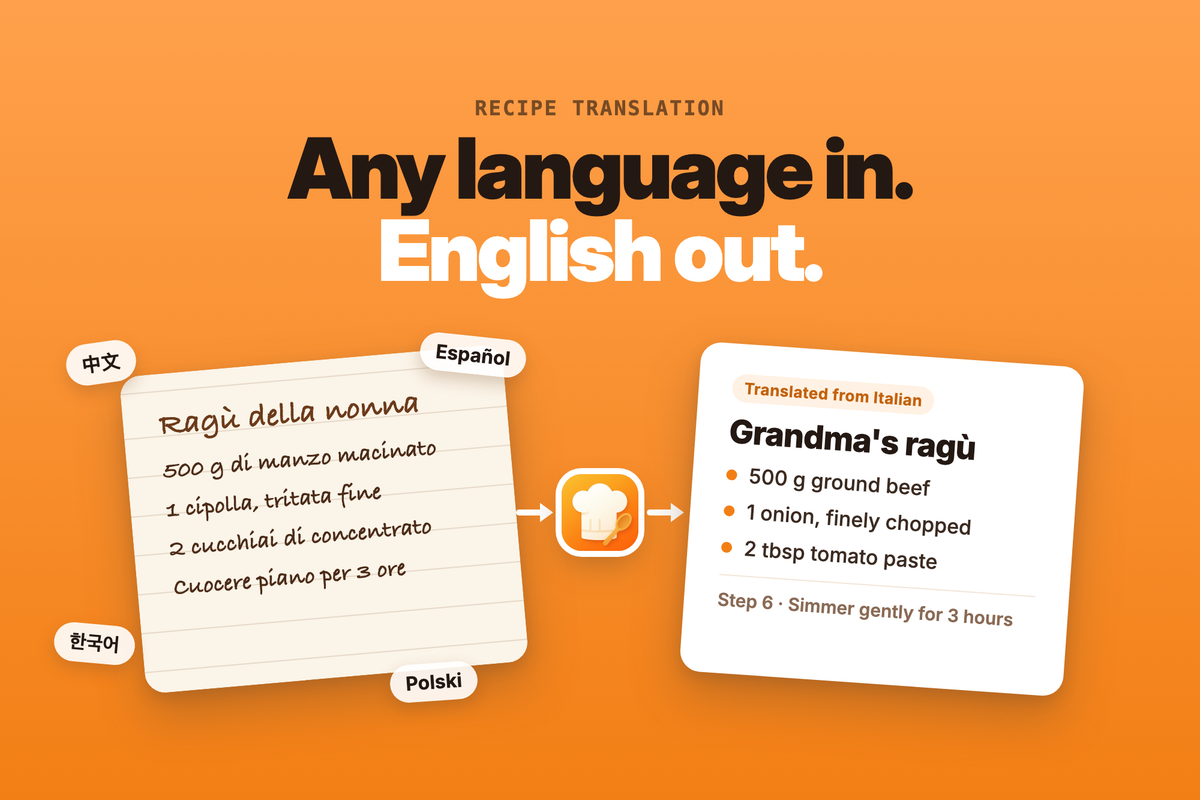
Your grandmother's handwritten recipe in Italian. That viral Korean street food post. The French pastry blog you've been bookmarking for months. They're all about to become a lot more useful.
ChefTalk now automatically translates recipes from any language into English during import. Whether you're photographing a cookbook in Mandarin or pasting a URL from a Spanish food blog, the app handles the translation seamlessly.
How It Works
The translation happens invisibly during import. You follow the same process you always have:
From a photo: Capture cookbook pages or handwritten recipes in any language. The app reads the text and translates it as part of the extraction process.
From any source: Food blogs, social media posts. If ChefTalk can import it, it can translate it.
The translated recipe appears in your library ready for voice-guided cooking, just like any English recipe.
Why Translation Matters
Cooking wisdom doesn't respect language barriers. The best pizza dough technique might be explained in Neapolitan dialect. The clearest dumpling-folding instructions could be in Cantonese. That perfect shakshuka recipe exists in Hebrew.
Translation opens up the entire world of cooking knowledge. You're no longer limited to English-language recipe sources. Every food culture, every regional specialty, every family tradition becomes accessible.
What Gets Translated
Everything that makes a recipe useful:
- Recipe titles and descriptions
- Complete ingredient lists with measurements
- Step-by-step cooking instructions
- Timing and temperature guidance
- Chef's notes and helpful tips
- Serving suggestions and variations
Current Limitations
Voice guidance currently works in English only. This means:
- Translated recipes work perfectly with voice-guided cooking
- The original language needs to use a writing system ChefTalk can read
- Handwritten text quality affects translation accuracy
We're working on expanding voice support to more languages. For now, translation makes international recipes accessible through English voice guidance.
How to Translate a Recipe Into English
To translate a recipe into English, there are three good ways, and the right one depends on where the recipe lives.
With a translator app
A translator app is the quickest route for text you can copy: paste it into Google Translate or DeepL. For a printed page or a handwritten card, both can work from a picture: Google Translate has a camera mode, and DeepL's iPhone app translates photos and PDF files. What you get is a translation to read, which you then copy somewhere you can cook from.
With your browser
For a recipe on a website, let the browser do the work. In Safari on iPhone, tap the page menu in the address bar, then Translate to English. Chrome offers a translation at the top of the page and translates it for that visit. Either way you are reading the blog in English, not saving the recipe, so bookmark the page if you want it again.
On import, in ChefTalk
Or let ChefTalk do it as the recipe comes in. Share the recipe's link to ChefTalk, whatever its language, and it lands in your library already in English, ready to cook. That part is free. On Premium you can photograph a cookbook page or a handwritten card instead, and it is read and translated the same way. Translation always goes into English, the language ChefTalk speaks while it leads you through the recipe action by action.
What to check before you cook
Whatever did the translating, read the numbers against the original before you start. A translation changes the words around the numbers, so look closely at four things:
- Units. 200 grams of flour is not 200 millilitres, and neither one is a cup. Grams, millilitres and spoons may need converting to match your measuring kit.
- Oven temperatures. A recipe in Celsius needs converting if your oven shows Fahrenheit: multiply by 1.8 and add 32, so 180°C is 356°F.
- Ingredient names. A translator picks the dictionary word, and a cook might have meant something more particular. When a name looks odd, search the original word with the name of the dish.
- Handwritten shorthand. Family recipes skip what the writer knew by heart: a glass of flour, bake until it looks right. No translation can fill that in, so ask whoever wrote it, or whoever grew up eating it, while you can.
Try It Yourself
Import your first international recipe today. Find a recipe in any language (Italian pasta blog, Japanese bento site, Mexican cookbook, French pastry guide) and import it into ChefTalk.
The app handles the translation. You handle the cooking.
Which recipe have you never been able to read? Download ChefTalk on the App Store.
At ChefTalk, we're building a voice-first cooking companion that transforms any recipe into hands-free guidance, action by action. Learn more.