Are AI Recipes Reliable? What Goes Wrong, and What to Cook From Instead
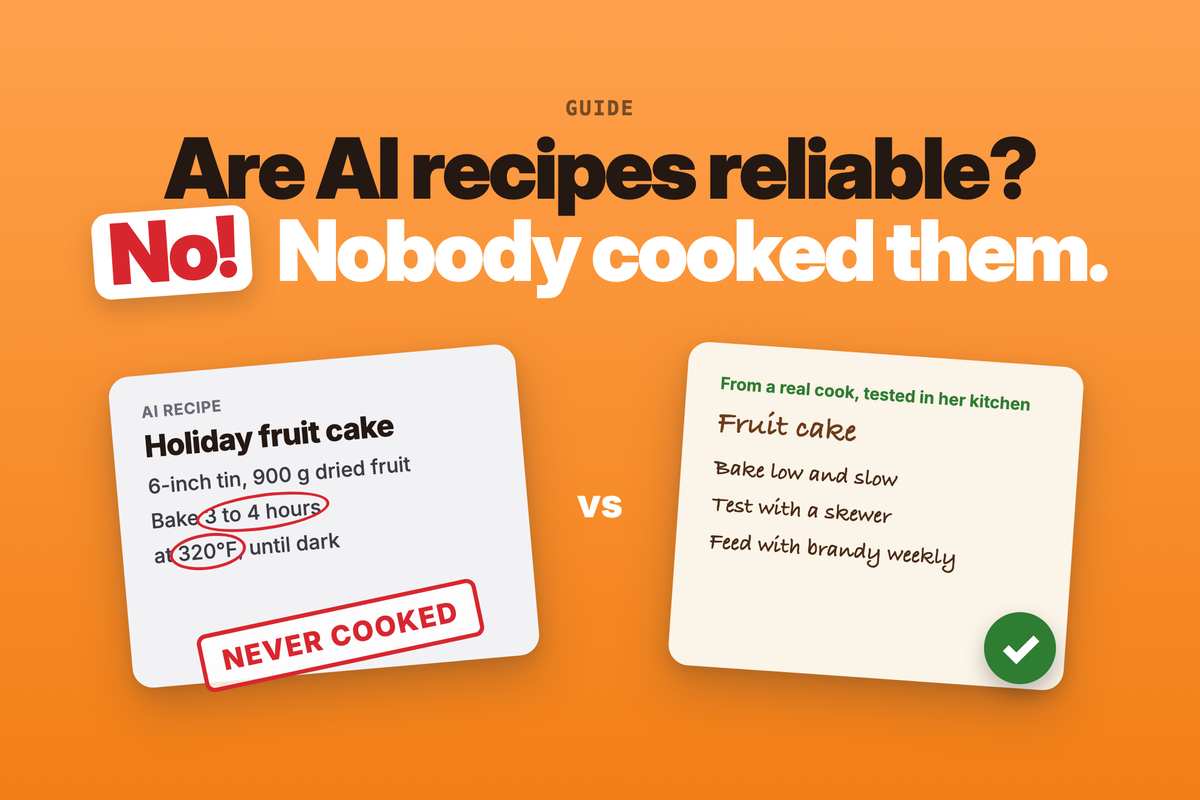
No. Nobody has ever cooked an AI recipe, so its ratios, cook times and food-safety steps are guesses you only get to check at the stove. Cook from a recipe a person has tested, and let AI help you follow it, never write it.
You asked a chatbot for a quick weeknight bake and it answered in four seconds, confident and nicely formatted. Forty minutes later the middle is raw, the edges are dark, and you are scrolling back up the chat looking for the step you got wrong. Usually there isn't one. The recipe was never cooked by anyone, so there was nobody to catch the mistake before you did.
What Goes Wrong With AI Recipes
An AI model writes a recipe the way it writes anything else: it predicts what a recipe for that dish usually looks like. It has never tasted, timed or burned anything, so it cannot notice when the numbers stop adding up. Food writers and food scientists who have tested AI recipes keep finding the same kinds of errors.
| What went wrong | Example | Source |
|---|---|---|
| Time and temperature | An AI version of a 6-inch holiday fruit cake said to bake it for 3 to 4 hours at 320°F. The recipe's author said, "You'd end up with charcoal!" | Bloomberg via Fortune, Nov 2025 |
| Food safety | ChatGPT canning recipes with too little vinegar "to lower the pH to 4.6 or below", the wrong headspace, and pressure canning steps with no adjustment for altitude | University of Minnesota Extension, Jul 2024 |
| Food-safety advice | Across 20 food-safety questions, ChatGPT agreed with food-safety specialists 40% of the time; the best chatbot tested managed 80% | Purdue, Journal of Food Protection, Sep 2026 |
| Texture and ratios | AI cottage cheese breadsticks came out "more like an eggy sheet with herbs" and scored 0 out of 5 | The Cut, via Futurism, Mar 2026 |
| Small slips | One recipe used all its olive oil in the first step, then called for "the remaining" oil later; another listed 200°C as 400°F | Thrive Market, updated Jan 2026 |
The canning errors are the ones to take seriously. A cake that burns costs you an afternoon. A jar of sauce that is not acidic enough can make someone ill, and nothing about it looks wrong when you open it.
There is a quieter problem too. When an AI recipe does work, it is often because it borrowed heavily from a real one. In The Cut's test, the best-rated AI recipe was one the tester said "was most certainly stolen from Minimalist Baker." The recipe worked because a person had already cooked it. We wrote about where that leaves the cook when a stitched-together recipe fails in The Recipe That Failed You Was Never Cooked.
But Some AI Recipes Turn Out Fine
Sometimes they do. Thrive Market tried three AI recipe generators and all three dishes worked well enough, though they sometimes needed a human to correct them. That is not the same as reliable.
Reliable means you can trust a recipe before the oven is on. An AI recipe can't offer that, because there is nothing behind it: no cook who made it, no batch that failed and got fixed, nobody whose name is on it. When one works, it is either a lucky average or, as The Cut's test suggests, a real recipe wearing a disguise. Either way you are the first person to find out, with your ingredients, your evening and sometimes your guests.
So the useful question is not whether an AI recipe might work. It is why you would cook from a guess when the tested version, written by a person who made it, is usually one search away.
How to Check a Recipe Before You Cook It
Whether a recipe came from a chatbot, a video or a search summary, the same checks catch most problems:
- Is there a named cook behind it? A recipe on a cook's own site, with their name on it, is one someone has made. A recipe with no author has nobody accountable for it.
- Do the numbers look like other versions of the dish? Compare the oven temperature, time and main ratios against one or two trusted recipes. A cake baking for four hours, or a cup of salt in a loaf, stands out once you look.
- Are the safety temperatures right? The FDA's minimums are 165°F for all poultry, 160°F for ground meat, and 145°F for beef, pork, veal and lamb steaks, chops and roasts, with a 3 minute rest. The FDA's food handling page has the full list.
- Canning or preserving? Only use a recipe from a tested source such as your local extension service. Purdue's food scientists put it plainly: "you can use AI to begin your search, but you need to verify before you take action."
- Have other people cooked it? Comments and ratings from people who made it are a test the recipe has already passed.
Where AI Does Help in the Kitchen
The problem is not AI in the kitchen. It is AI as the author. Used on a real recipe, it is genuinely useful:
- Brainstorming: "what can I make with chickpeas, spinach and feta" is a fine question, as long as you then cook from a tested recipe for the dish it suggests.
- Answering questions mid-cook: what "fold" means, whether the onions are soft enough, what to do when the sauce splits.
- Helping you keep your place: reading a recipe aloud, one action at a time, so you are not scrolling with wet hands.
- Translating a recipe written in another language, with the cook's quantities left as they wrote them.
- Suggesting a swap when you are out of something, as long as you treat it as a suggestion and not as tested advice.
In every one of those, the recipe still belongs to the person who tested it. AI makes the recipe easier to follow without changing what it says.
How ChefTalk Uses AI
ChefTalk never writes recipes. You bring a recipe from a cook you trust, from a link to their site or, on Premium, a photo of a cookbook page, and ChefTalk keeps their words and measurements exactly as written. Then it leads you through the recipe out loud, action by action, sets the timers itself, and answers your questions in the context of the step you are on.
We made that choice on purpose, and wrote about why in We Cannot Trust AI to Create Recipes and We Don't Use AI to Create Recipes, We Use It to Make Them Accessible. ChefTalk is free on iPhone and iPad, with unlimited recipe imports and one guided cooking session a month on the free plan. It is not the right tool if you want a recipe invented for you, and that is the point.
Questions People Ask
Are ChatGPT recipes safe to cook?
Not reliably. ChatGPT has never cooked anything, and in a 2026 study it agreed with food-safety specialists on only 40% of food-safety questions. Check temperatures against the FDA's minimums and never use an AI recipe for canning.
Why do AI recipes fail?
Because an AI predicts what a recipe usually looks like instead of testing whether it works. Times, ratios and steps can drift from a version that would actually cook, and nobody checked before you did.
Can AI make a recipe from what's in my fridge?
It can suggest what to make, which is a reasonable use. For the recipe itself, cook from one a person has tested.
Are AI recipes copied from real recipes?
Sometimes closely. In one 2026 test, the best-rated AI recipe was one the tester said had wording nearly identical to a published recipe. That is also why crediting and linking the original cook matters.
Does ChefTalk use AI to write recipes?
No. ChefTalk only uses recipes written by people, and uses AI to guide you through them, answer questions and translate. The recipe's words and measurements stay as the author wrote them.
Got a recipe from a real cook you've been meaning to try? Try ChefTalk free on the App Store.
At ChefTalk, we're building a voice-first cooking companion that transforms any recipe into hands-free guidance, action by action. Learn more.