Mariah Gladstone's Indigikitchen: Native Foods for Today's Kitchen
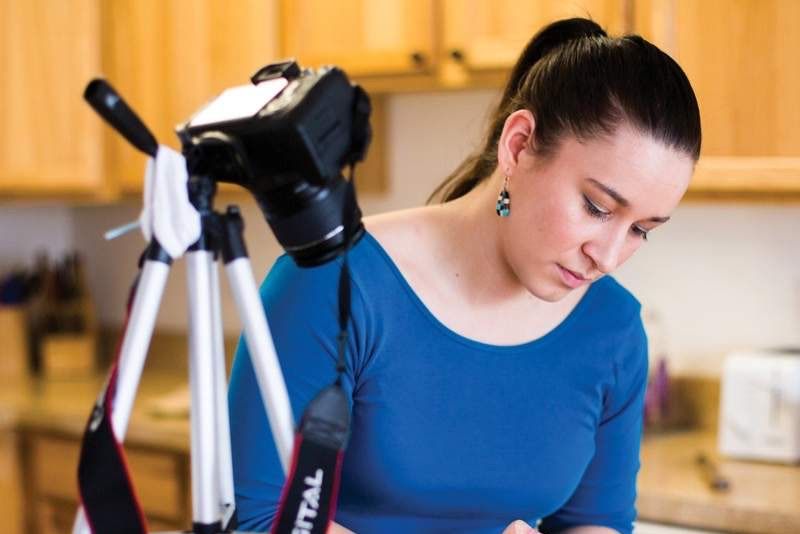
Mariah Gladstone (Blackfeet, Cherokee), creator of Indigikitchen, filming a cooking video. Photo by Celia Talbot Tobin, courtesy of indigikitchen.com
Indigikitchen Short cooking videos and recipes that bring Native foods back into everyday cooking indigikitchen.com

In 2016, Mariah Gladstone went to a Native nutrition conference in Minneapolis and said, almost in passing, that someone should start an Indigenous cooking show. Then she decided to be that someone. She bought a camera on eBay, tied it to a tripod with a headband, and filmed her first recipe. The video ran about 45 seconds, with captions and no voice, so that it would load on the slow internet connections on the reservation. Her goal, she told Columbia Magazine in 2023, was simple: "I wanted to make our traditional recipes Googleable."
That show became Indigikitchen. The name joins three words: Indigenous, digital and kitchen. On her About page, she introduces herself as "Mariah Gladstone (Blackfeet, Cherokee)" and says she grew up in Northwest Montana. She earned a degree in environmental engineering at Columbia University, then went home and built Indigikitchen, which has been her full-time work since 2018. She later completed a master's degree at SUNY College of Environmental Science and Forestry, through its Center for Native Peoples and the Environment.
The site's own description is "Revitalizing, reimagining, and recreating Indigenous foods." The recipes are built on foods native to the Americas: bison and elk, salmon and trout, wild rice, corn, beans and squash, sunflower seeds, maple and berries.
Indigenous Recipes as Cultural Work
Indigikitchen is not a diet plan. Her About page has a section called "Food as Resistance." Foods from before European contact, it says, "are a testament to the resilience of Native lifestyles and a delicious way of resisting colonization." The site describes its work as "re-indigenizing our diets," and says the show "strengthens the ties to our cultures."
That history is close to home for her. She told Columbia Magazine that when the US government nearly wiped out the buffalo in the 1800s, her Blackfeet ancestors lost a major resource, "not just for food but also clothing, shelter, tools, everything." She speaks about hard history like this openly, and she finds that food makes it easier to hear. "I talk about issues that a lot of people wouldn't touch," she said. With food as the way in, "it becomes storytelling." In that way she is close to Melissa Thompson of Fowl Mouths, who teaches Jamaican history through its food. And like Ozoz Sokoh of Kitchen Butterfly, a geologist who mapped Nigerian cuisine, she trained in science before she turned to food.
The cooking itself is modern. She uses a pressure cooker, suggests swaps for hard-to-find ingredients, and borrows from other cuisines: there is an Indigikitchen pad thai and a butternut bison lasagna. "Our culinary traditions are not stuck in the past," she said, "and neither are we." She is also careful about where each recipe comes from. Her "On the Road" series collects recipes from other Native cooks, gives each cook "full credit for the recipe," and pays $200 to film it. A mesquite blue cornbread in the series comes from Teresa Romero, on Chumash territory. The call for recipes also says what it will not take: frybread, commodity cheese and Spam, "as they are non-Native."
Two Pieces Worth Exploring
Potawatomi Berry Rice Her first recipe: sweet wild rice with berries and maple, from a college friend indigikitchen.com
Potawatomi Berry Rice is the recipe she filmed first, and the post explains where it came from. At Columbia, the Native students were a small group at a huge university, and they held potlucks and study breaks to look after each other. A Citizen Potawatomi student always brought a sweet wild rice dish. After graduation, Gladstone writes, "I hounded her for the recipe." Her version simmers wild rice with dried cranberries for about 45 minutes, until the water is gone, then stirs in fresh berries, maple syrup and cinnamon. Raspberries, huckleberries, saskatoon berries or blackberries all work. She calls it "a recipe from the Great Lakes area," and she dedicates it by name to her friend, Lakota Pochedley, and to "the community that got me through college." It is a short post, but it shows how she works. The recipe keeps the names of the people it came from.
Bison Chokecherry Sloppy Joes Ground bison simmered with chokecherry juice and maple sugar, first made for school lunches indigikitchen.com
Her Bison Chokecherry Sloppy Joes began as a recipe for school cooks. Indigikitchen worked with the Montana Partnership to End Childhood Hunger on a toolkit that helps school food service directors find and serve more Native foods at breakfast and lunch. The sloppy joes are ground bison, browned and then simmered with tomato paste, water and chokecherry juice. The spice mix is maple sugar, smoked paprika, cumin, onion, garlic, salt and pepper. After the bison is browned, it needs only 5 to 10 minutes on the stove. On whole wheat buns, the meal is easy for schools to count under their nutrition rules. "However," she writes, "we also recognize that whole wheat buns are not Indigenous." So she gives other ways to serve it: over wild rice, in corn tortillas, on arepas, in white bean fritters, or over summer squash noodles. This is her approach in one recipe. She works with the kitchens and rules people actually have, and still points the way toward Native ingredients.
Why It Matters
"We're missing a lot of information on how to prepare food," Gladstone told High Country News in 2018. Indigikitchen fills some of that gap, and it puts the recipes where people already are. "Indian Country is small and Facebook is a digital telegraph," she told Cronkite News in 2025, so a recipe can reach many communities quickly. She told CBC about messages from people who cooked her recipes with what they had, like one family with no bison: "But we had a whole bunch of caribou in our freezer. So we did it with that, and it turned out great." People are not only cooking the recipes, she said, "they're also building a culture for their family and their community."
The site does not post often. The newest recipes, a green chile bison stew with potatoes and hominy and a sunflower seed "cheesecake," went up in March 2026, more than two years after the one before. Much of her work happens away from the site: school programs, cooking classes, talks, the board of FAST Blackfeet, and a cookbook for children, Mountains to Oceans: Kids' Recipes from Native Land, published in 2024 with more than 40 recipes. But the archive is all there: 36 recipes since 2017, most with a short video. Start with the berry rice and the story of the friend who first brought it to a potluck. Ten years after that first video, Mariah Gladstone is still doing what she set out to do: making Native foods easy to find and easy to cook, first for Native families, and then for anyone who wants to learn.
Sources
- Indigikitchen, About Us and Indigikitchen "On the Road"
- Columbia Magazine, Putting Native Foods Back into Native Diets, Spring/Summer 2023
- High Country News, Organic reach: Food sovereignty moves to the web, 2018
- CBC Radio, Recipes for resistance: Indigikitchen teaches diet decolonization, 2019
- Cronkite News, IndigiKitchen founder, Navajo lifestyle blog connect to Native communities, April 2025
Explore Indigikitchen: https://www.indigikitchen.com
We're featuring exceptional food blogs that bring unique perspectives to cooking and culture. At ChefTalk, we're building a voice-first cooking companion that transforms any recipe into hands-free guidance, action by action. Learn more.